
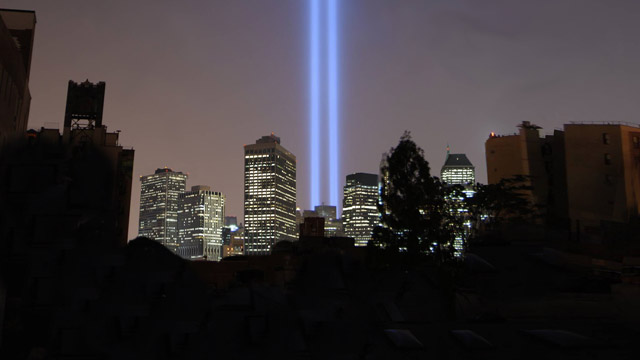
 The 10th anniversary of September 11th is a fitting time for a New York professor of international relations to launch a blog about America and the World. This first post looks forward more than backwards at the events of that fateful day. Below is an op ed I co-authored and publish first on this blog which argues for greater public education and civil defense measures in the event of a nuclear terrorist attack, one of my concerns before and after 9/11. While New Yorkers were still in shock after the attack I remember returning to my introductory IR class and sharing with these new students my past predictions that terrorists would return to the Twin Towers to try to knock them down and my fear that the next strike would also involve weapons of mass destruction. It turned out better on September 11th to be only 50 percent right.
THE DAY AFTER
By Cynthia Roberts and Andrew Sherlock
Imagine the day after 9/11 if the 19 hijackers affiliated with al-Qaeda had instead collaborated on a suicide mission to detonate a nuclear warhead in midtown Manhattan or another major American city. A catastrophe of untold death and destruction would still be unfolding. Nothing would have saved the hundreds of thousands, possibly more than a million New Yorkers and city workers murdered by the initial blast, fireball, and radiation on an average workday. However, millions more New Yorkers would survive these initial effects, even in Manhattan. They would face fires and lethal and spreading radioactive fallout among other hazards. What the shocked and injured survivors of a nuclear explosion do in the first 48 hours after a detonation will determine whether they live or die.
Based on daytime population estimates, if terrorists detonate a 10 kiloton weapon (about the yield of the Hiroshima bomb), our model estimates the effects of the blast, shock wave, and prompt nuclear radiation would kill approximately 560,000 people or about 85 percent of those within a radius of 1.3 kilometers, (about 16 city blocks). The subsequent thermal radiation and effects from accumulated fallout could be expected to kill another 500,000 people, about half of the survivors within a 2 kilometer radius (roughly 25 city blocks). The living victims of such a terrorist attack cannot depend on first responders to help them in the crucial minutes and hours after the blast. Power, phones, and access to the internet will be knocked out in the area, and emergency personnel outside the affected zone will need time to mobilize and respond in the chaotic and dangerous conditions following a nuclear detonation.
In major disasters, an individual’s chance for survival often depends on whether they learned a few essential techniques beforehand. Just as informed people watching the ocean water recede right before a tsunami hits know to run immediately to high ground, city dwellers need to react rapidly and instinctively to shelter themselves from the initial radioactive fallout. Radioactive particles begin to deposit in the first fifteen minutes after a nuclear detonation, and fallout spreads in a localized area over the next 24 to 48 hours. Depending on prevailing weather and wind patterns, the fallout plume from a 10 kiloton improvised nuclear device will likely extend a few tens of miles downwind in a relatively narrow, cigar shape with a width of a few miles. With telecommunications out or unreliable in affected and nearby zones, individuals must know ahead of time what they should do and in what order.
In the immediate aftermath of an attack, if the mushroom cloud and smoke is heading towards you, individuals need to try to get out of its path, heading perpendicular to the plume. Then people should quickly get off the streets, recognizing that automobiles (if they are running) are much less likely to save them than an underground shelter. To stay alive, survivors must avoid a panicky race to leave their offices or apartment buildings if they are relatively undamaged and not vulnerable to imminent fire or gas leaks. Ideally firms and building managers have previously identified appropriate places to shelter from deadly gamma rays, for example in a basement behind thick walls. Parents need to have confidence that schools have similarly designated shelters because in most cases 15 minutes is too little time to retrieve children in the path of lethal nuclear radiation. Individuals additional miles away from Ground Zero should strive for situational awareness about wind patterns spreading radiation before attempting to evacuate. Vital arteries are likely to be jammed, and evacuees put themselves at greater risk of contamination if they head out in the open in the wrong direction. If no official directives have been issued or heard, individuals should try to determine which way the wind is blowing (in the Northeast it is usually west to east) and if it makes sense in their conditions, then head perpendicular to the plume to get out of its path before taking shelter. Such civil defense awareness, like fire drills can save lives, and in times of austerity are cost effective.
During the Cold War, plans for civil defense against thousands of thermonuclear warheads detonating in the United States were unrealistic, even perversely comic as many schools taught children to shelter under their classroom tables. However, civil defense measures today could be extremely effective in the event of a single, relatively low yield improvised nuclear detonation or a handful of other notable disasters, such as a radiological “dirty bomb” which is much less lethal but still contaminates an area of the city center. Civil defense programs should be resurrected and modernized for businesses, schools and communities in America’s major cities. Like Japan, which engages in extensive public education and preparedness for earthquakes, America’s major cities should inform and involve their citizens in basic preparedness. If city and local officials are reluctant to take the lead, community leaders and concerned citizens should organize symposia and grass roots information sessions.
A nuclear attack is the paradigmatic low-probability, high-cost event which constrains policy planning. Public complacency has also risen given the difficulty of executing a strike with weapons of mass destruction and also because counter-terrorism programs have helped to prevent another major attack on American soil in the decade since 9/11. However, there is no guarantee that terrorists still plotting against the United States or other extremists will not succeed in striking with WMD. In the last decade, there were more than a dozen terrorist plots against New York City, and documents found in Abbottabad show that Bin Laden never abandoned his goal of attacking New York again. No one knows for sure, but experts and officials have estimated the chances of a deliberate terrorist nuclear explosion in an American metropolis in the next decade to be between 29 and 50 percent.
Since 9/11, the U.S. Department of Homeland Security has developed comprehensive plans for responding to major disasters, including a nuclear detonation. Yet more needs to be done to coordinate disaster responses among federal, state and local authorities and train first responders under realistic conditions. Despite its world-class counter-terrorism and police work, New York City is not immune to inter-departmental coordination problems and like other major cities is reluctant to engage in needed public outreach for civil defense.
Although several nuclear effects models of a terrorist attack are available, few official and academic studies use New York City in their modeling. There is persistent sensitivity to the World Trade Center tragedy and a desire not to further frighten people. We believe such concerns are misplaced and that information reduces anxiety and error. Likewise, public education about how to respond to a nuclear detonation does not detract from our collective remembrances and respectful tributes to fellow New Yorkers and others who perished on 9/11. A decade later, the day after September 11th should henceforth be dedicated to disseminating useful emergency information and engaging in practical preparations in the event of a WMD attack or other major disaster. If there is a deadly future attack, hundreds of thousands of citizens may have a smaller chance of making it to the day after, if they don’t take the time today to learn how to survive.
Cynthia Roberts teaches international relations at Hunter College, CUNY and is an adjunct senior associate of the Saltzman Institute for War and Peace Studies at Columbia University. Andrew Sherlock is a senior at Hunter College High School and an intern with the Hertog Global Strategy Initiative at Columbia.
© 2011 Cynthia A Roberts.
 Cynthia A Roberts